Showing posts with label art. Show all posts

Friday, March 6, 2009

Furoshiki


Furoshiki is the eco-friendly wrapping cloth. Although possibly dating back as far as the Nara period (feudal period), Furoshiki means "bath spread"- they were used to bundle and protect people's clothing at public bath houses). Before becoming associated with public baths, furoshiki was known as hiradzutsumi, or flat folded bundle. Eventually, the furoshiki’s usage extended to serve as a means for merchants to transport their wares or to protect and decorate a gift. Bbut over the years, their standard use has been to tie up any bundle you can imagine (they've even been used as baby carriers). The word is pronounced something like "f'-ROHSH-kee".

Modern furoshiki can be made of a variety of cloths, including silk, cotton, rayon, and nylon. Furoshiki are often decorated with traditional designs or by shibori, chirimen. There is no one set size for furoshiki, they can range from hand sized to larger than bed-sheets. The most common sizes are 45cm and 68-72cm. wikipedia

The techniques are much similar to origami, which it can be used for gift wrapping, grocery shopping or simply as decor. It is reusable and multipurpose. Each year billions of plastic bags end up as litter; reusable bags, such as furoshiki can help reduce the impact to our environment. Its versatility allows you to wrap almost anything regardless of its shape or size.


Various Design of Cloth


Featured Technique


Or download pdf file here:


Modern Furoshiki used fo
r laptop/notebook computers and contemporary techniques combines handles for easy carrying.


Sources:
http://furoshiki.com/
http://9brand.com/en/work/standard/furoshiki/index.html
http://layersofmeaning.org/wp/?p=325
http://www.infomapjapan.com/hstore/200709-infospecial.phtml

Y(^0^)Y


Wednesday, June 18, 2008

Chirimen & Wagashi Workshop

Chirimen Handicraft Workshop

A pocket tissue case with type of fabric that is weaved specially to create crepe on its surface.


Date: 5 July 2008 (Sat)

Time: 10am – 12noon
Venue: The Japan Foundation, Kuala Lumpur (JFKL)
Participation Fee: RM15
Telephone Booking: Only on 26 (Thu) & 27 (Fri) June 2008 at 03-2161 2104
Ticket Collection: From 27 (Fri) to 2 (Wed) July 2008 at JFKL

*Limited to 25 participants
**Max 2 tickets per person
***We can't accept any walk-in participants

For further enquiry, please kindly contact 03-2161 2104 or email to jpcc@jfkl.org.my

Wagashi Demonstration and Workshop

A traditional confectionery made of natural ingredients such as mochi (glutinous rice), azuki (red bean paste) and fruits.


Date: 2 July 2008 (Wed)
Time: 1st Session: 10am ~ 12pm, 2nd Session: 2pm ~ 4pm
Venue: Hotel Nikko Kuala Lumpur, Bentley’s Pub (1st Floor)
Participation Fees: Normal Fee: RM20, Students / JFKL Membership: RM10

*** Number of participants is limited.
Tickets are available at JFKL office from 13 to 25 June 2008.

Please call Mr. Hafiz at 03-2161 2104 for further information.

Resource and For more Info and Details Visit http://www.jfkl.org.my/

Y(^O^)Y

Monday, July 23, 2007

Ikebana

Rikka style. Arranged by Sen'ei Ikenobo Headmaster, Ikenobo SchoolShoka shinputai styleIkenobo schoolWhile flower arrangement for many people in the West consists of symmetrically arranging flowering plants in a vase, Japanese Ikebana (literally 'flowers kept alive') is a lot more complex. There are many schools, of which the most popular are Ikenobo, Sogetsu and Ohara. There are also different styles depending on the school and the plants and vase used.Ikenobo is the oldest school of ikebana, founded by Buddhist priest Ikenobo Senkei in the 15th century. He is thought to have created the rikka (standing flowers) style. This style was developed as a Buddhist expression of the beauty of nature, with seven branches representing hills, waterfalls, valleys and so on arranged in a formalised way. The present 45th-generation head of the school is Ikenobo Sen'ei. The school is based in the Rokkakudo temple in Kyoto, believed to have been started by Prince Shotoku. Among the priests and aristocrats, this style became more and more formalised until, in the late 17th century, the growing merchant class developed a simpler style, called seika or shoka. Shoka uses only three main branches, known as ten (heaven), chi (earth) and jin (man) and is designed to show the beauty of the plant itself.

Another old form of ikebana is nageire, used in the tea ceremony.The first of the modern schools was formed when Ohara Unshin broke from the Ikenobo school in the late 19th century. The Ohara school generally uses moribana (piled-up flowers) in a shallow, flat container. The school was started at a time when Western culture was heavily influential in Japan and the moribana style made good use of Western plants. But it was still a formal style. Influence from the artistic movements of the early 20th century led to the development of jiyuka (free-style) arrangement. Despite all the changes, ikebana was still only for the upper class.

In the 1930's and then more so in the postwar period, interest in ikebana became much more widespread. Ikebana schools opened which attracted people of all social classes. During the occupation, many wives of US servicemen took up the art and later helped it spread abroad. Led by Teshigahara Sofu, founder in 1927 of the Sogetsu school, zen-eibana or avant-garde ikebana introduced all kinds of new materials, such as plastic, plaster and steel.Today, there are about 3,000 ikebana schools in Japan and thousands more around the world. The Ikenobo school alone has some 60,000 teachers worldwide. Ikebana is practised by about 15 million people in Japan, mostly young women.Ikebana can be roughly divided into two styles - the moribana shallow vase style and the nageire tall vase style. The Sogetsu school uses a series of kakei (patterns) for each style so that even the beginner can quickly create their own arrangements. As an example, let's look at the moribana Basic Upright style. Kakeizu for the arrangement shown on the left(copyright Sogetsukai Foundation). The photo shows the frontal view as in the illustration.

The shushi are the three main branches - the shin (truth) branch, the soe (supporting) branch and the hikae (moderating) branch. The arrangement of these branches and the kenzan or spiked metal holder are drawn in a simple diagram, called a kakeizu. The kakeizu shows a frontal and overhead view of the arrangement. After examining the kakeizu, suitable branches or flowers are chosen for the shushi and trimmed if necessary. The stems are cut to correct lengths according to set formulae. The kenzan is placed in the vase and just covered with water. The sushi are fixed to the kenzan in order and according to the kakeizu. Jushi or short supplementary stems are added to support the shushi and give depth to the arrangement. Finally, the composition is examined and any finishing touches applied.

Japanese Woodblock Print

Japanese Woodblock Print -Ukiyo-e

The name of this art form literally means pictures of the floating world. The term 'floating world' refers to a generally hedonistic way of life, and was often used as a euphemism for the bars and houses of ill-repute which were so popular among artists and literary types in pre-war Japan. Ukiyo-e wood-block prints first appeared early in the Edo Period

(1600~1868) and depicted stories set in this after-hours world. Flashy kabuki actors and stylish courtesans were the most popular subjects. Later artists started depicting scenes from nature and works such as Hokusai's views of Mt. Fuji (see below) are among the most famous today.

The prints were a collaboration between artist, publisher, wood-block carver and printer although they are almost always accredited to the artist and publisher only. Ukiyo-e were often used for book illustrations but really came into their own as single-sheet prints. They played a role much like modern-day pulp fiction and thanks to a rapidly increasing level of literacy, became extremely popular among the middle class. Another role was that of posters for the kabuki theater, which was also rapidly gaining in popularity. Ukiyo-e also played their part in the development of Western art in the late 19th century, influencing such important artists as Van Gogh, Monet, Degas and Klimt.

In the mid-18th century, techniques were developed to allow full-color printing and the ukiyo-e which we see reproduced today on post cards and calendars date from this period on. Utamaro and Hokusai are the big names from this period, and other prominent artists include Hiroshige and Sharaku.
Kitagawa Utamaro (1753~1806) is famous for his depictions of beautiful women from the tearooms (above), shops and pleasure quarters of Edo. He also designed some of the most beautifully illustrated books in the history of ukiyo-e.

Katsushika Hokusai (1760~1849) is best known for his nature scenes and his series 'Thirty-six Views of Mt. Fuji'. This series started a whole new style of landscape ukiyo-e. The famous illustration of a giant wave engulfing fishing boats, with Mt. Fuji merely a background detail (top right), is one of the most familiar Japanese works of art.

Ukiyo-e remain part of the Japanese cultural identity today and elements of the more famous works are often incorporated into modern art and design. Reproductions can be picked up for a very reasonable price in souvenir shops. They make excellent souveniers for anyone who wants to take home something quintessentially Japanese (and light!).

Beneath the Waves off Kanagawa (from the series '36 Views of Mt. Fuji', 1831) - Hokusai Kambara (from the series '53 Stations of the Tokaido Road', 1833~4) - Hiroshige. For a good, and entertaining, read about what remained of the Edo entertainment districts in the first half of this century, you could do worse than check out Kazuo Ishiguro's novel 'Artist of the Floating World', short-listed for the Booker Prize in 1986. The writer grew up in the UK and writes in English.

Japanese Pottery

Japanese Cultural Society is very proud to share with you the beauty and splendor of Japanese pottery. Shigarakiyaki is ranked as one of the best Japanese pottery producers in Japan. It has been producing pottery for hundreds of years. It is also designated by the Ministery of Economy, Trade and Industry of Japan as the Japanese Traditional Craft Products under the Law for promotion of Traditional Craft Industries.
Style of japanese pottery:
Arita-yaki – Produced in Saga. Introduced by Korean potters at the beginning of the Edo Period.Also called Imari-yaki.
Bizen-yaki – Produced in Okayama. Also called Inbe-yaki. A reddish-brown pottery, which is believed to have originated in the 6th century.
Hagi-yaki – Produced in Yamaguchi. Since it is burned at a relatively low temperature, it is fragile and transmits the warmth of its contents quickly.
Karatsu-yaki – Produced in Saga. The most produced pottery in western Japan. Believed to have started in the 16th century. Greatly influenced by Korean potters.
Kutani-yaki – Produced in Ishikawa.
Mino-yaki – Produced in Gifu. Includes Shino-yaki, Oribe-yaki, Setoguro, and Ki-Seto.
Onda-yaki – Produced in Kyūshū. Produced by families and passed on only to their own children. The outstanding fact is that they still produce it without electricity.
Raku-yaki – Produced in Kyoto. There is a proverb of the hierarchy of ceramic styles used for tea ceremony: 'First, Raku(-yaki). Second, Hagi. Third, Karatsu.'
Ryumonji-yaki – Produced in Kagoshima. Started by Korean potters about four hundred years ago.
Satsuma-yaki – Produced in Kyūshū and other areas. Started by Korean potters about four hundred years ago.
Seto-yaki – Produced in Aichi. The most produced Japanese pottery in Japan. Sometimes, the term Seto-yaki (or Seto-mono) stands for all Japanese pottery.
Shigaraki-yaki – Produced in Shiga. One of the oldest styles in Japan. Famous for tanuki pottery pieces.
Souma-yaki – Produced in Fukushima. Image of a horse (uma or koma), which is very popular in this area, is the main pattern. Therefore, it is sometimes called Soumakoma-Yaki.
Tamba-yaki – Produced in Hyōgo. Also called Tatekui-yaki. One of the six oldest kinds in Japan.
Tokoname-yaki – Produced in Aichi. Most are flower vases, rice bowls, teacup.
Tobe-yaki – Produced in Shikoku. Most are thick porcelain table ware with blue cobalt paintings.
Yokkaichi-Banko-yaki –Produced in Mie. Most are teacups, teapots, flower vases, and Sake vessels. Believed to have originated in the 19th century.


Origami

Origami (折り紙, origami?) (literally meaning "folding paper") is the art of paper folding. The goal of this art is to create a given result using geometric folds and crease patterns. Origami refers to all types of paper folding, even those of non-Asian origin.

Origami only uses a small number of different folds, but they can be combined in a variety of ways to make intricate designs. In general, these designs begin with a square sheet of paper, whose sides may be different colors, and usually proceed without cutting or fastening the paper. Contrary to most popular belief, traditional Japanese origami, which has been practiced since the Edo era (1603-1867), has often been less strict about these conventions, sometimes cutting the paper during the creation of the design (Kirigami 切り紙) or starting with a rectangular, circular, triangular or other non-square sheets of paper.

Special origami paper, often also referred to as "kami" (Japanese for paper), is sold in prepackaged squares of various sizes ranging from 2.5 cm to 25 cm or more. It is commonly colored on one side and white on the other; however, dual coloured and patterned versions exist and can be used effectively for color-changed models. Origami paper weighs slightly less than copy paper, making it suitable for a wider range of models.

Foil-backed paper, just as its name implies, is a sheet of thin foil glued to a sheet of thin paper. Related to this is tissue foil, which is made by gluing a thin piece of tissue paper to kitchen aluminium foil. A second piece of tissue can be glued onto the reverse side to produce a tissue/foil/tissue sandwich. Foil-backed paper is available commercially, but not tissue foil; it must be handmade. Both types of foil materials are suitable for complex models.

Washi
(和紙, Washi?) is the predominant origami paper used in Japan. Washi is generally tougher than ordinary paper made from wood pulp, and is used in many traditional arts. Washi is commonly made using fibers from the bark of the gampi tree, the mitsumata shrub (Edgeworthia papyrifera), or the paper mulberry but also can be made using bamboo, hemp, rice, and wheat.

Artisan papers such as unryu, lokta, hanji, gampi, kozo, saa, and abaca have long fibres and are often extremely strong. As these papers are floppy to start with, they are often backcoated or resized with methylcellulose or wheat paste before folding. Also, these papers are extremely thin and compressible, allowing for thin, narrowed limbs as in the case of insect models.

Paper money from various countries are also popular to create origami with, called "Moneygami". It is common to create the figure depicted on the note itself.


Try yourself: Origami Club

Japanese Weddings

Japanese Weddings

Contemporary Japanese weddings are celebrated in variety of ways including Shinto, Buddhist, or Christian style. Many contain elements from traditional Japanese and western culture. The rituals of cake cutting, exchanging rings and honeymoons are a few of the western traditions that have been adopted. The Japanese wedding I saw took place at a Shinto Shrine. The bride wore a wedding kimono of white silk and the groom wore a black kimono decorated with his family crest in white. Usually, only the bride and group, their immediate families, and the go-betweens attend the religious part of the Shinto wedding. A Shinto priest first offers prayers to the deities, then the groom makes his marriage oath. Next, the couple performs the Sansan-kudo exchange of nuptial cups. San-san-ku means 3 * 3 = 9 and the small, medium and large cups are each brought to the lips three times with one sip each time.

Friday, July 6, 2007

Ukiyoe


Ukiyo-e (浮世絵, Ukiyo-e), "pictures of the floating world", is a genre of Japanese woodblock prints (or woodcuts) and paintings produced between the 17th and the 20th centuries, featuring motifs of landscapes, the theatre and pleasure quarters. It is the main artistic genre of woodblock printing in Japan.

Ukiyo, meaning "floating world", refers to the impetuous young culture that bloomed in the urban centers of Edo (modern-day Tokyo), Osaka, and Kyoto that were a world unto themselves. It is an ironic allusion to the homophone term "Sorrowful World" (憂き世), the earthly plane of death and rebirth from which Buddhists sought release. The art form rose to great popularity in the metropolitan culture of Edo (Tokyo) during the second half of the 17th century, originating with the single-color works of Hishikawa Moronobu in the 1670s. At first, only India ink was used, then some prints were manually colored with a brush, but in the 18th century Suzuki Harunobu developed the technique of polychrome printing to produce nishiki-e.

Ukiyo-e were affordable because they could be mass-produced. They were meant for mainly townsmen, who were generally not wealthy enough to afford an original painting. The original subject of ukiyo-e was city life, in particular activities and scenes from the entertainment district. Beautiful courtesans, bulky sumo wrestlers and popular actors would be portrayed while engaged in appealing activities. Later on landscapes also became popular. Political subjects, and individuals above the lowest strata of society (courtesans, wrestlers and actors) were not sanctioned in these prints and very rarely appeared.

History
Ukiyo-e can be categorized into two periods: the Edo period, which comprises ukiyo-e from its origins in the 1620s until about 1867 , when the Meiji period began, lasting until 1912 . The Edo period was largely a period of calm that provided an ideal environment for the development of the art in a commercial form; while the Meiji period is characterized by new influences as Japan opened up to the West.

The roots of ukiyo-e can be traced to the urbanization that took place in the late 16th century that led to the development of a class of merchants and artisans who began writing stories or novels, and painting pictures, compiled in ehon (絵本, picture books, books with stories and picture illustrations), such as the 1608 edition of Tales of Ise (Ise-monogatari ,伊勢物語) by Hon'ami Kōetsu. Ukiyo-e were often used for illustrations in these books, but came into their own as single-sheet prints (e.g., postcards or kakemono-e) or were posters for the kabuki theater. Inspirations were initially Chinese tales and artworks. Many stories were based on urban life and culture; guidebooks were also popular; and all in all had a commercial nature and were widely available. Hishikawa Moronobu, who already used polychrome painting, became very influential after the 1670s.

In the mid-18th century, techniques allowed for production of full-color prints, called nishiki-e, and the ukiyo-e that are reproduced today on postcards and calendars date from this period on. Utamaro, Hokusai, Hiroshige, and Sharaku were the prominent artists of this period. After studying European artwork, receding perspective entered the pictures and other ideas were picked up. Katsushika Hokusai's pictures depicted mostly landscapes and nature. His Thirty-Six Views of Mount Fuji (富嶽三十六景, Fugaku sanjūrokkei) were published starting around 1831 . Ando Hiroshige and Kunisada also published many pictures drawn on motifs from nature.

(by : Haru ~_~")

Thursday, June 21, 2007

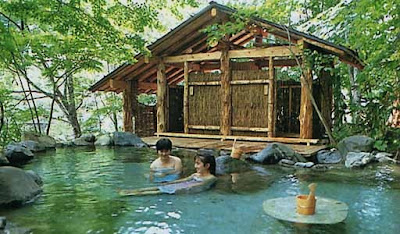
Hot Spring in Japan

Hot springs are a big part of Japanese culture. It would be shocking to hear that there was a Japanese person that had never visited one.

Many springs are developed, having an associated outdoor bath (rotenburo or notenburo) and/or indoor bath. Baths may be either public run by a municipality or private (uchiyu ) often run by a local inn (ryokan) or B&B (minshuku ).

Onsens are often found out in the countryside, and are a major tourist attraction drawing Japanese couples, families or company groups who want to get away from the hectic life of the city to relax. Japanese often talk of the virtues of 'naked communion' (裸の付き合い, hadaka no tsukiai)) for breaking down barriers and getting to know people in the relaxed homey atmosphere of an onsen inn.

The springs are split up into men's area and women's area. In the past the men's area was considerably larger than the women's area. However, in recent times many hot spring resorts have a larger women area. This is because the average person taking a trip or vacation these days tends to be female. Some hot spring resorts rotate the sex of the areas every day.Some hot springs have coed baths, but they are not that common.

Natural and "unnatural" hot springs

Not all hot spings are natural, meaning that the source of the spring comes from the earth. Usually the natural hot springs come from a nearby volcano and the water has a strong sulfur smell to it. A natural hot spring is called an onsen.
Hot springs which are not from a natural source, but are heated artificially are called sentou. A sentou can be just as relaxing as an onsen with the exception that the smell of sulfur is not present.

How to bath?


1) Take off all your clothes in the changing room and place them into a basket together with your bath towel. Coin lockers for valuables are often available.

2) Japanese hot springs are enjoy naked. Swimming suits are not allowed in most places. However, it is the custom to bring a small towel into the bathing area, with which you can enhance your privacy while outside of the water. Once you enter the bath, keep the towel out of the water.

3) Before entering the bath, rinse your body with water from either a tap or the bath using a washbowl provided in the bathing area. Just rinsing your body is usually sufficient unless you are excessively dirty, in which case you want to use soap.

4) Enter the bath and soak for a while. Note that the bath water can be very hot (typical temperatures are 40 to 44 degrees). If it feels too hot, try to enter very slowly and move as little as possible.

5) After soaking for a while, get out of the bath and wash your body with soap at a water tap, while sitting on a stool. Soap and shampoo are provided in some baths. Like in private Japanese bathroom, make sure that no soap gets into the bath water. Tidy up your space after you finished cleaning your body.

6) Re-enter the bath and soak some more.

7) After you finished soaking, do not rinse your body with tap water, for the minerals to have full effect on your body.

You WASH my back, I'll WASH yours!?
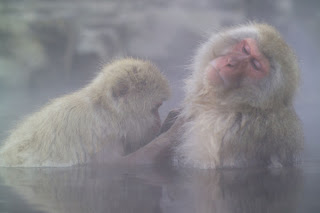
While washing prior to entering the springs it would not be strange if someone offers to wash your back. This normally doesn't happen out of the blue, but the person you have struck up a conversation with just might offer. While in other countries the offer might be taken the wrong way, in Japan it is just a common courtesy.
If you have the chance, I would highly recommend that you visit a Japanese hot springs, it is quite worth it.


Glossary of Terms

*onsen 温泉- a natural hot springs

*sentou 銭湯 -a hot spring in which the water is heated by man made means

*oyu お湯-hot water

*onnayu 女湯-female bathing area

*otokoyu 男湯-male bathing area

*konyoku 混浴-coed bathing area

*rotenburo 露天風呂 or notenburo 野天風呂 -outdoorbath

*uchiyu 内湯 -indoor bath

*ryokan 旅館 -hotel

*minshuku 民宿- Bed and Breakfast (a type of boarding house typically operating out of a large single family residence.)
by Aeris ^-^